• SenseColour / light
  • ActAddressable RGB LEDs
  • UserAquarium keeper
  • Form factorClip-on
  • VibeSteampunk
  • TwistBuilt into a found object

Aquatica Lumina

A design proposal for a colour-sensing aquarium accent light that matches the colours of the tank it hangs over.

The idea: a slim brass-and-gunmetal light bar, styled like a fitting from Captain Nemo's salon, clips under the aquarium lid. When the room goes dim it wakes and flashes white for an instant to read the colours of the water, plants and fish. Then it lights the surface in a palette that matches them, or plays against them. When a fish rises under its faceted dome, a slow ripple runs along the lamps.

300 × 26 × 11 mm
About a foot long, phone-thin
Clips under the lid
On a stick-on rail, so it can't fall in
~4 nights a charge
At a dim glow, 5 hours a night, USB-C
No app to install
Its own Wi-Fi control panel
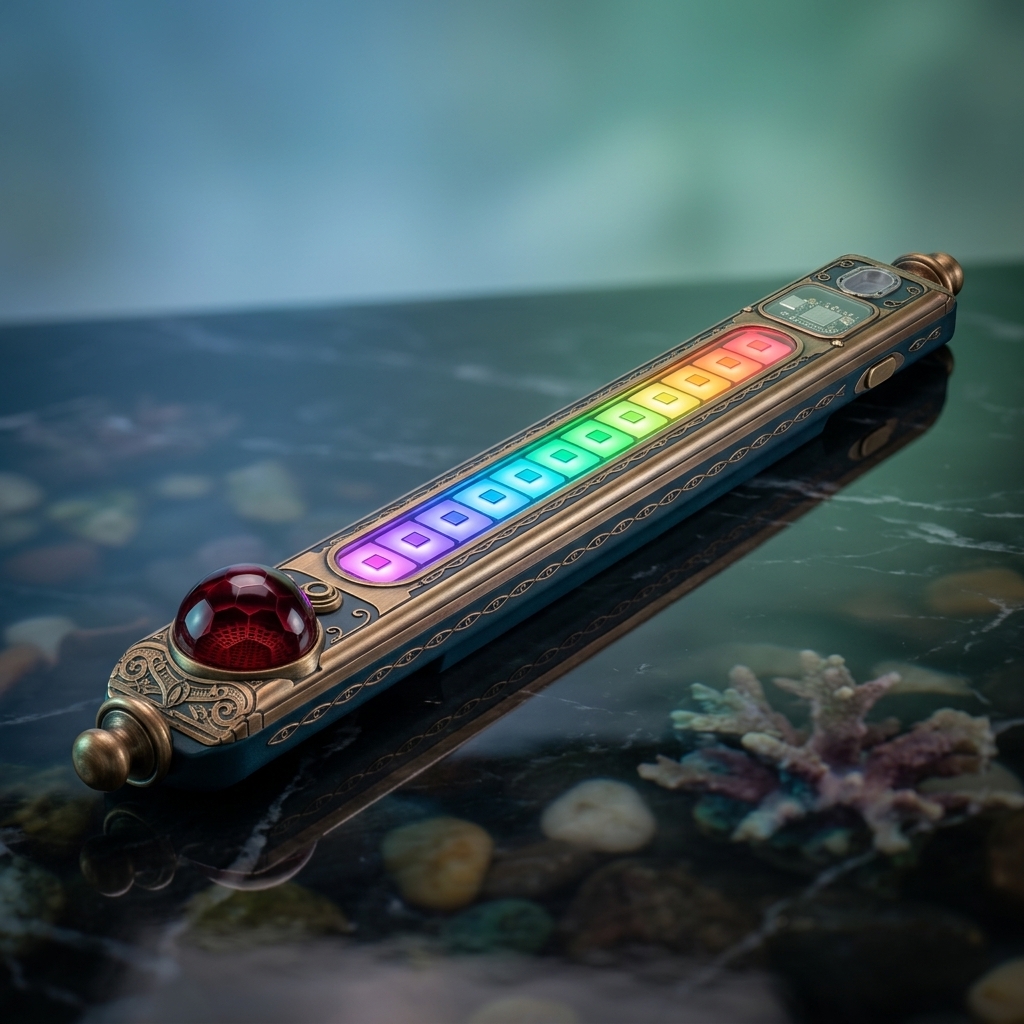
AI render: a slim antique-brass and gunmetal light bar with turned finials, a faceted red glass dome at one end and twelve square lamps glowing in a rainbow, lying on dark wet stone beside coral
An AI render of the CAD model: a concept that hasn't been built. The render tinted the dome ruby; the CAD calls for smoky amber.

One keeper, a few dozen fish

The keeper would set it up. The fish would have to live with it.

The keeper

Tests the water weekly, tinkers with everything

A hobbyist with a planted tank in the living room, the kind who would happily open a control panel to set a timer or pick an animation. The bar is designed to be the tank's evening light: it would come on by itself when the room goes dim, pick its colours from what's actually in the tank, and switch off on schedule.

The fish

Didn't ask for a light show

So the design keeps it quiet: a dim mood light at around 5 % brightness, colours that fade over seconds instead of flashing, and a sensor that would answer movement near the surface with one gentle ripple. Out of the night window, the lamps are switched off completely.

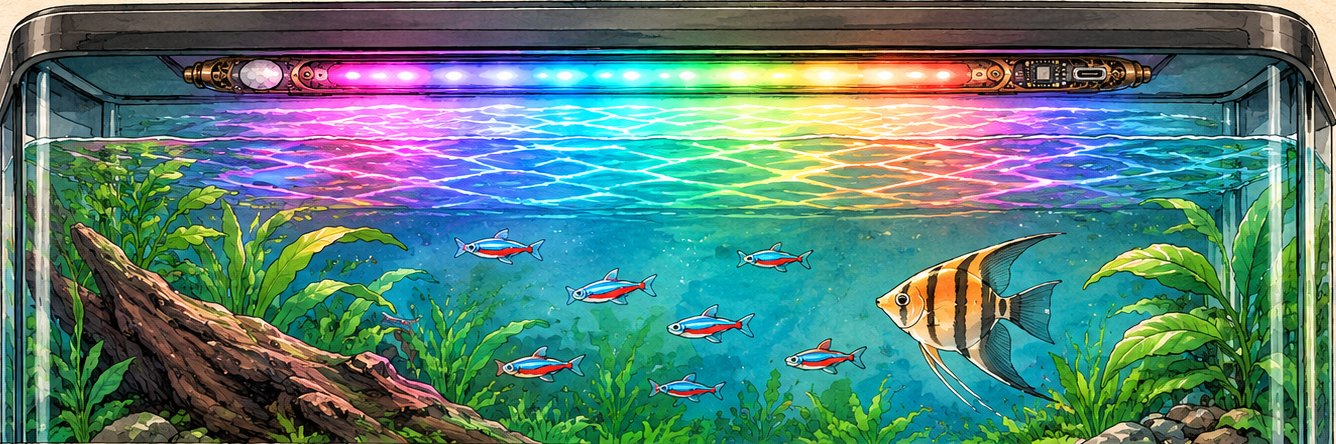
Concept art: the brass light bar under an aquarium lid, the water surface below it lit in rainbow ripples over neon tetras, an angelfish and green plants
"It looked at the tetras and turned the surface red and electric blue."Nine at night, room lights off. The bar reads the tank once at dusk and paints it back onto the water.

It reads the tank, then plays it back

Pick a tank and a mode. The bar flashes white for a moment, its colour eye reads what bounces back, and the twelve lamps settle into a palette. Then send a fish up under the dome.

An aquarium seen from the front, with the brass light bar under its lid lighting the water in the chosen palette

Lumina control panelHosted by the bar · N° 004

The tank below
Mode

A simulation of how the light is designed to behave: no firmware has been written yet. The tank colours here stand in for what the colour sensor would read, and the real bar hangs face-down, so you'd see the light on the water, not the lamps.

43D model in Solidcraft

A brass bar you could actually mould

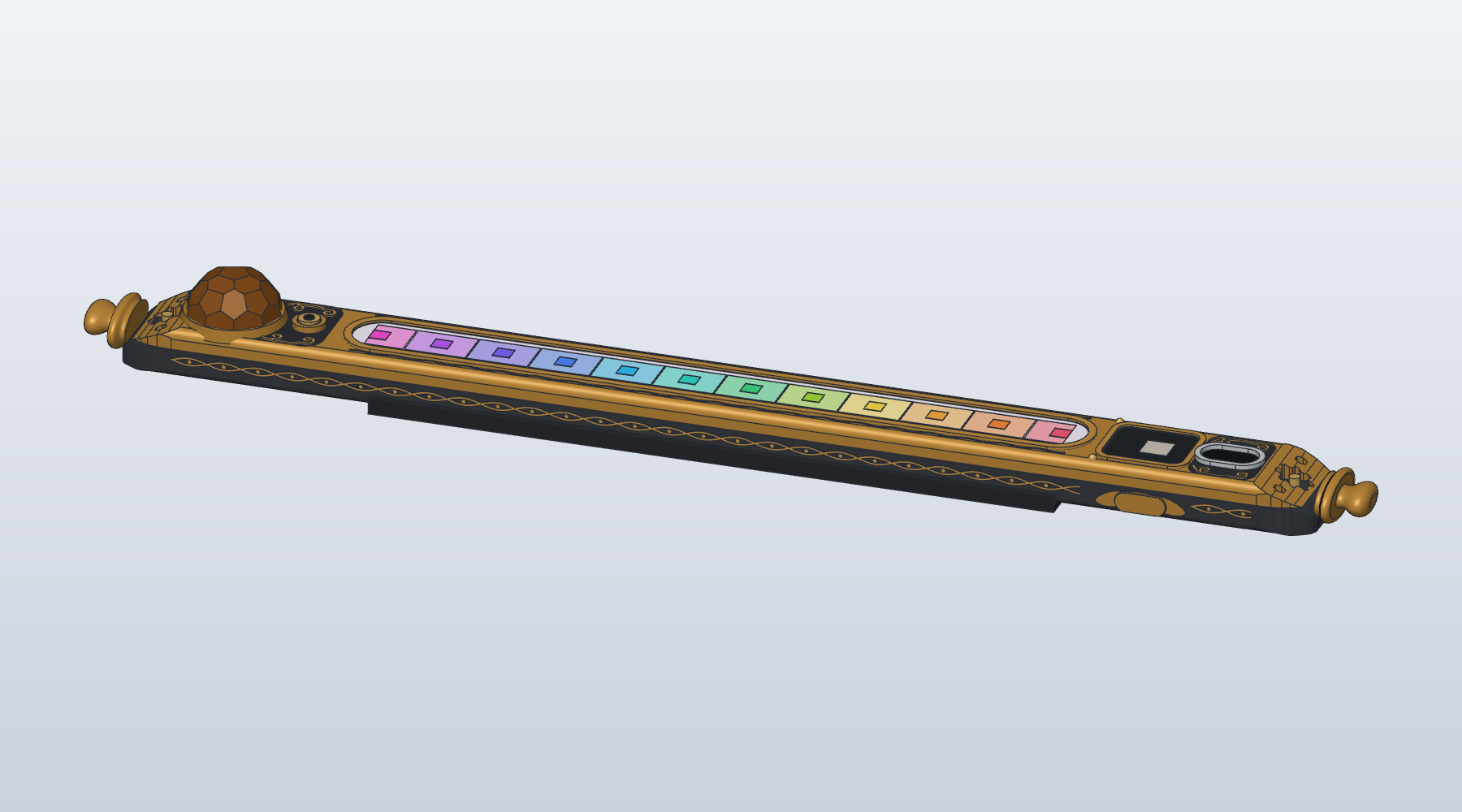
A first-pass CAD model sized around real parts: 300 mm long, 26 mm wide and 11 mm thick, with the dome standing 10 mm proud. The lamp face points up here; under the lid it would hang face-down over the water. Drag to spin it.

  1. Brass deck over a gunmetal baseTwo moulded halves split along a visible step and sealed with a silicone cord, painted and antiqued to look like milled brass. Splash-proof, not submersible.
  2. Faceted domeSmoky amber and see-through to infrared. The sensor behind it watches for fish near the surface and for the room going dark.
  3. Porthole buttonA brass eyepiece over a tiny switch: wake, change mode, or hold to open the Wi-Fi control panel.
  4. Lamp windowTwelve squares on a frosted diffuser, one RGB LED behind each.
  5. Viewing window and colour eyeSmoked glass over the microcontroller, then a chrome oval over the colour sensor.
  6. Side USB-C and clip railThe charging port hides behind a tethered brass plug on the long edge. A 160 mm rail stays taped under the lid; the bar snaps in and out of it.
5Electronics in KiCad

What's inside

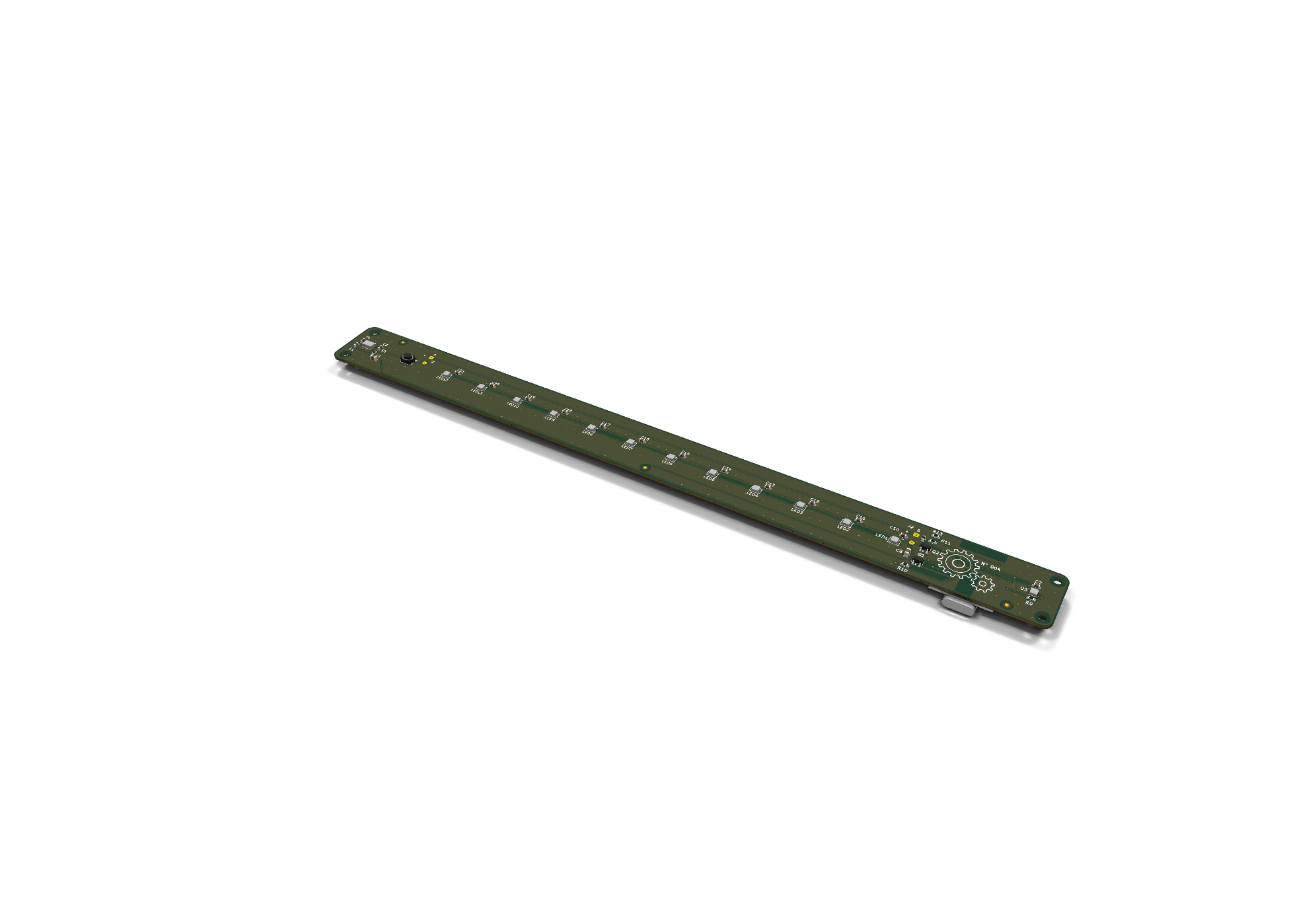
One long two-layer board, 248 × 21.4 mm, runs almost the whole bar. The lamps, sensors and button face the water; a XIAO ESP32-C6 is soldered flat on the back, with its USB-C at the side edge. Two slim LiPo pouch cells lie underneath.

0 / 0DRC violations and unrouted connections
51Parts on the board, plus two 600 mAh cells
~55 mANight draw at a dim glow; ~30 µA asleep by day
Routed in KiCad with Freerouting
U1 · XIAO ESP32-C6

The brain

Wi-Fi for the control panel, USB-C, LiPo charging and a 15 µA deep sleep on one thumb-sized board. It's soldered flat, because sockets would add 8 mm to an 11 mm bar.

U2 · APDS-9960

Fish and dusk

Pulses infrared through the dome and reads what comes back, so a fish near the surface changes the reading. Its ambient channel says when the room is dim.

U3 · APDS-9251-001

Colour eye

A true RGB + IR sensor behind the chrome oval. The lamps flash white for a moment and it reads the colour that bounces back from the tank.

LED1–12 · WS2812B-2020

The lamps

Twelve 2 mm RGB LEDs, one under each window square, on a single data line.

Q1, Q2 · AO3401A + AO3400A

Day switch

Cuts power to the whole LED chain outside the night window, since each LED draws about 1 mA even when dark.

SW1 · PTS810

Porthole

A 2.5 mm-tall switch under the brass button. It's wired to a pin that can wake the chip from deep sleep.

Full bill of materials (… lines)
Loading the parts list…

How we got here

From a random roll to a routed board in one episode. The twist, "built into a found object", became the aquarium itself: the thing the light lives on and reads. Along the way the concept's PIR sensor became an optical one (a PIR can't see through water) and the USB-C moved from the face to the side edge.

The episode, in short. A quick walk through episode 004, from the idea to the brass bar and its board. Pressing play loads the video from YouTube. Watch it on YouTube
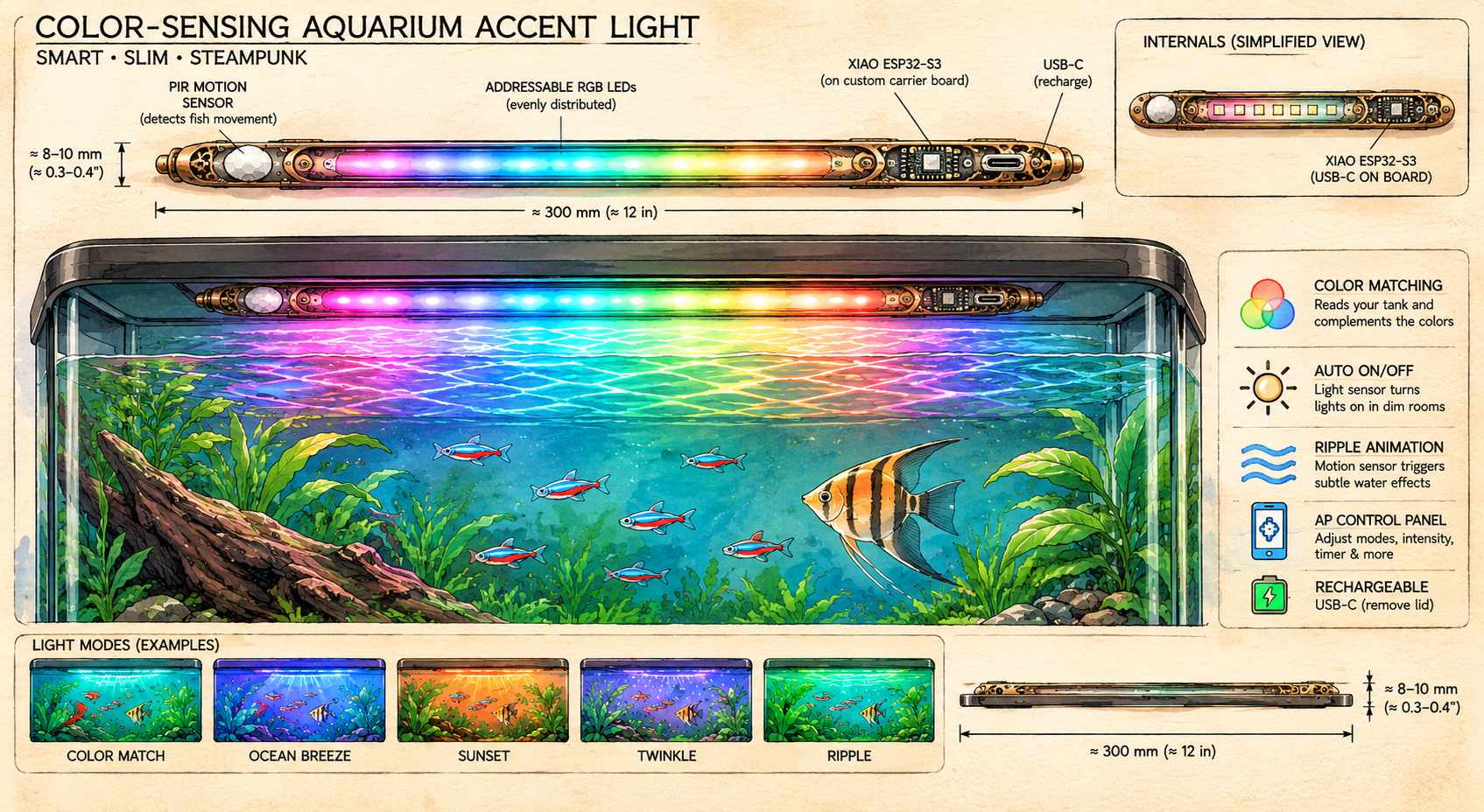
  1. Concept board: the steampunk light bar, the tank it lights, and five example light modes
    ConceptThe chosen concept board
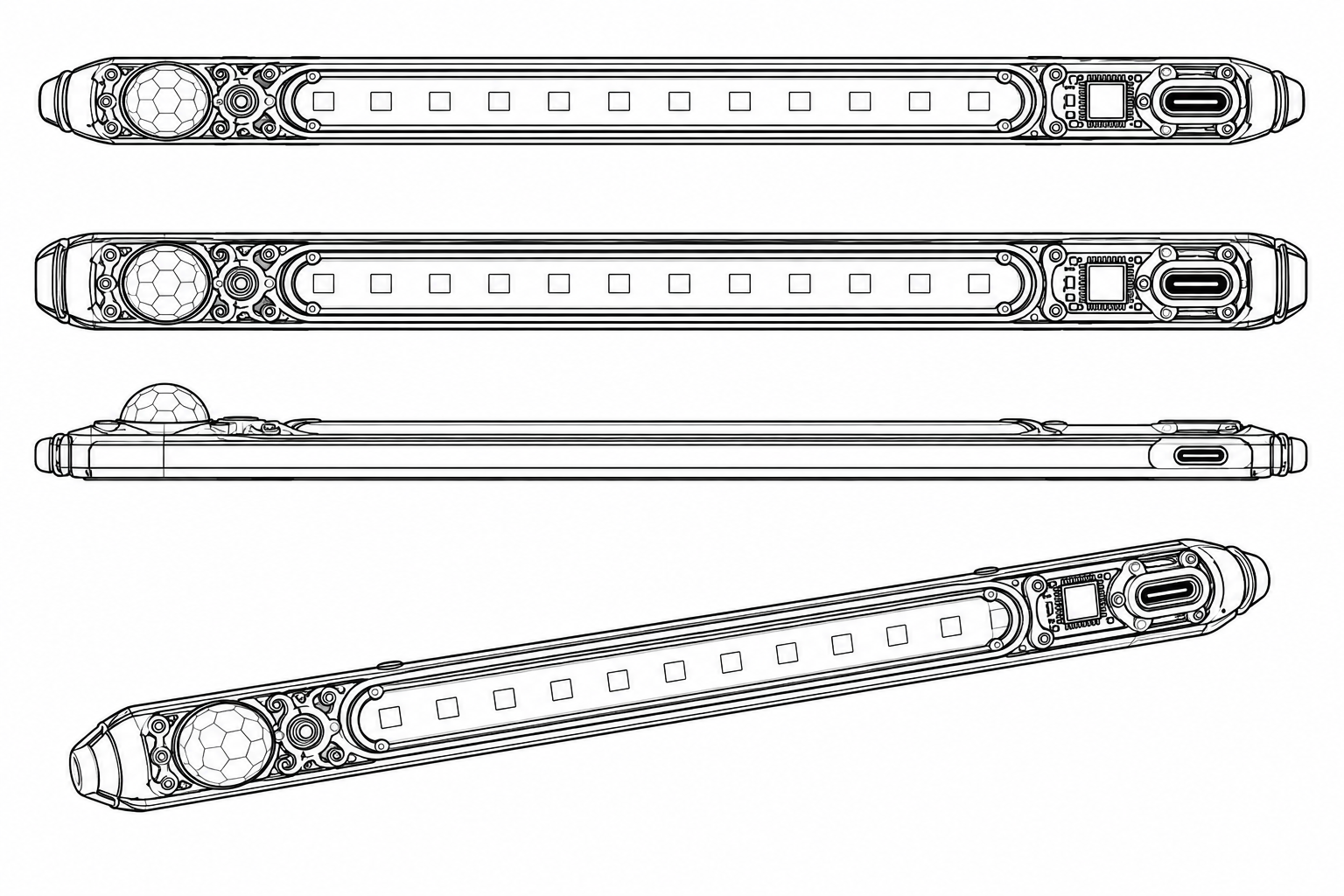
  2. Control drawing: face, side and three-quarter views of the bar
    Control drawingFace, side and three-quarter views
  3. Isometric view of the CAD model
    3D modelSolidcraft enclosure
  4. 3D render of the routed carrier board
    ElectronicsThe 248 mm carrier, routed

What we still don't know

This is a speedrun first pass. Here's what we'd answer before anyone orders a board or cuts a mould.

  • Board

    Routed and clean, but never built

    The XIAO ESP32-C6's battery pads and antenna end are taken from Seeed's footprint and wiki. Both need checking against a real board before ordering.

  • Sensing

    Can it see fish through water?

    Water soaks up the sensor's infrared within a few centimetres, so it would only notice fish near the surface. The firmware could also watch the colour sensor for fast flicker as a second cue.

  • Colour

    What does one sensor make of a whole tank?

    It reads the blended reflection of everything below, not each fish. Whether that blend turns into a palette people actually like is untested.

  • Dome

    Which amber resin passes infrared?

    Amber and smoke dyes are usually near-clear at 950 nm, but tinted plastics vary. The chosen resin needs a proximity test before it's committed.

  • Power

    Blue fades on a tired battery

    The LEDs run straight from the cell, and below about 3.6 V their blue dims, so the firmware would stop at 3.5 V and ask for a charge. A 5 V boost would fix it. Charging could also take around 12 hours.

  • Finish

    Brass paint versus Wi-Fi

    A metallic-flake "brass" would detune the antenna, so the patch above it needs a non-metallic finish. The rail's snap grooves also leave a thin 0.7 mm wall.

Build on it

Everything behind Aquatica Lumina is open: the 3D design, the KiCad boards and the notes. Download it, change it, make it, even sell it. All we ask is a credit and a link back.

Open the project on GitHub

Continue it with an AI agent

Paste this into Claude Code, Codex, Cursor or any agent that can run commands. It fetches just this project and its part libraries, reads the notes in the right order, and asks you before it changes anything.

Hardware under CERN-OHL-P v2, words and images under CC BY 4.0, code under MIT.

Get each run by email

A short diary of every episode: the roll, the turns the idea took, and the board at the end. One email per episode.