• BrainnRF52840
  • UserAngler
  • Form factorWearable
  • VibeTiki
  • TwistReacts to music

HeadLine

A design proposal for a bucket hat whose band is a full-colour LED screen that scrolls your messages, dances to the music and helps your friends find you in a crowd.

The idea: an ordinary-looking bucket hat with a 12 × 208 pixel screen sewn in where the hatband goes. From a phone app you'd send it scrolling text, pixel art or a light show that pulses with the music around you. With the screen dark it keeps broadcasting over Bluetooth, so friends' phones can find you at a crowded festival. The electronics would hide in a slim pod behind the sweatband.

2,496 pixels
12 × 208 RGB, all the way round
One band, any hat
Designed for a hat maker to sew in
Bluetooth beacon
So friends' phones can find you
~1–1.5 h of show
Weeks as a beacon alone
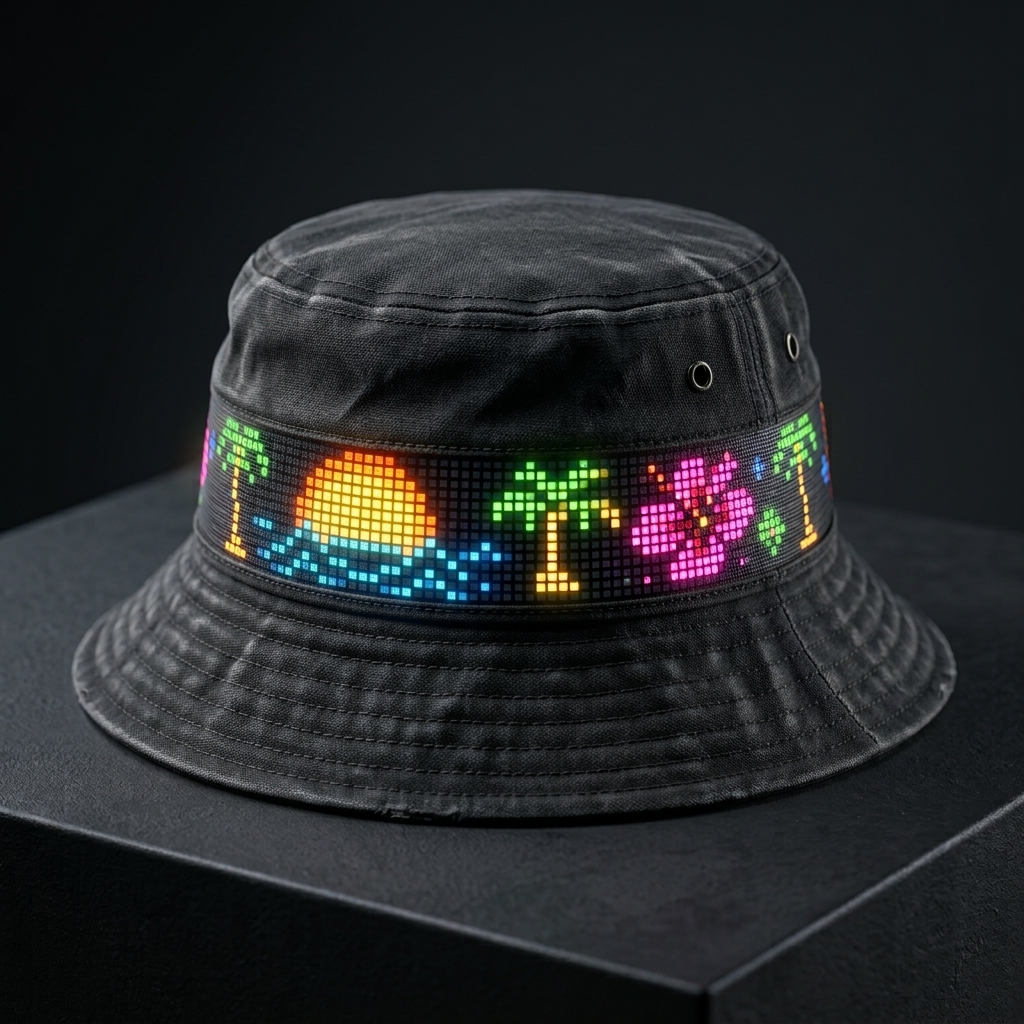
A charcoal bucket hat on a black plinth, its band a grid of glowing square pixels showing an orange sunset over blue waves, palm trees and a pink hibiscus
An AI render of the CAD model: a concept that hasn't been built. The CAD covers the LED band; the hat around it would be any hat maker's.

Out on the lake, lost in the crowd

The roll said angler. The tiki vibe said festival. The bucket hat already belongs to both.

The angler

Already owns three bucket hats

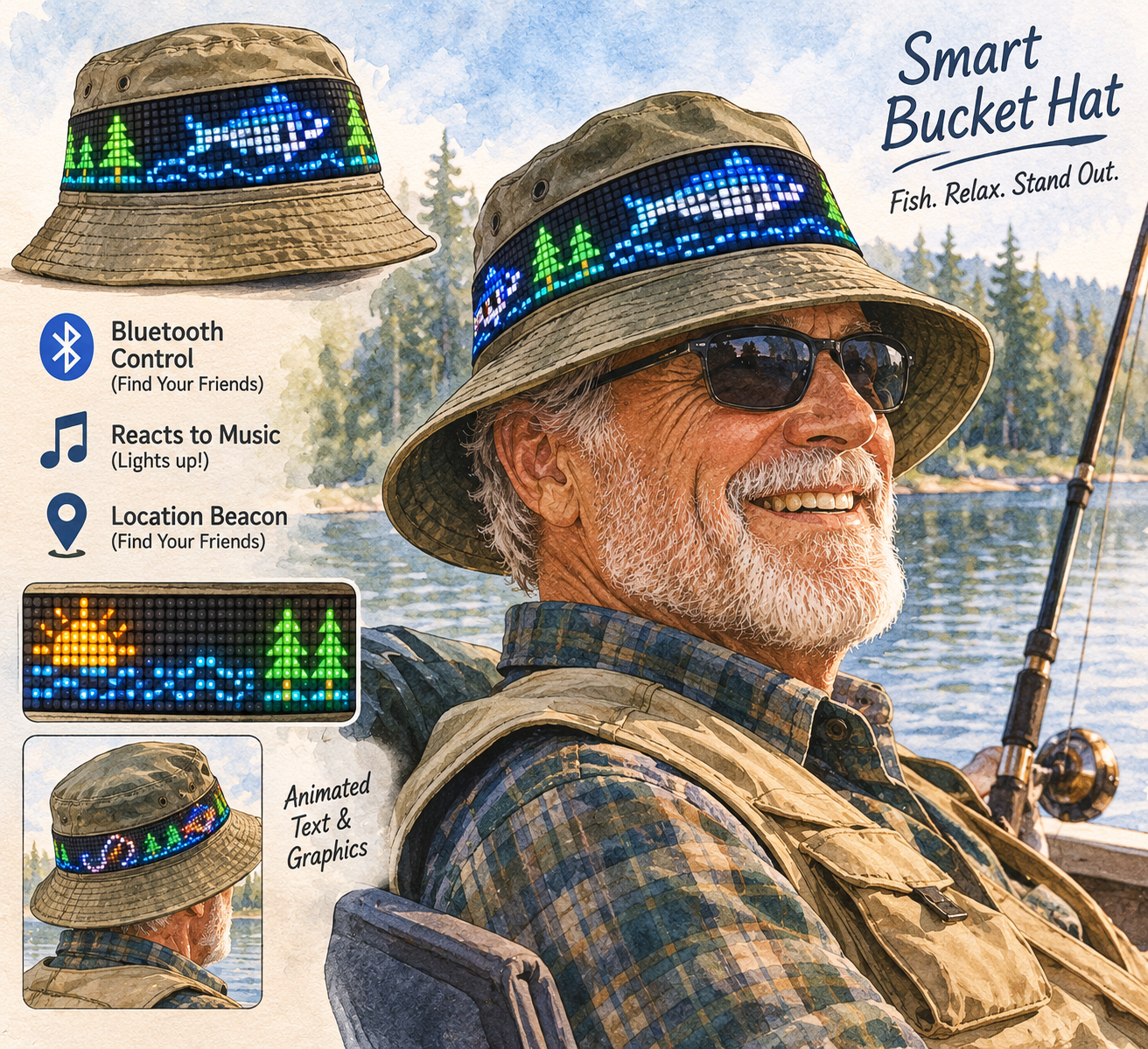
It's their uniform for a day on the water. This one would look like any other hat until they wake it: a fish jumping over the waves for the boat, the boat's name scrolling round the back, or nothing at all. In beacon mode the band stays dark and the battery could last for weeks, so the crew can find whoever wandered off down the shore.

Festival-goers, playa camps, tiki-bar regulars

Lost their friends by the second set

The hat would scroll their camp's name above the crowd and pulse with the bass. When everyone scatters, their friends' phones could pick up its Bluetooth signal and say "warmer" or "colder" until they're back together.

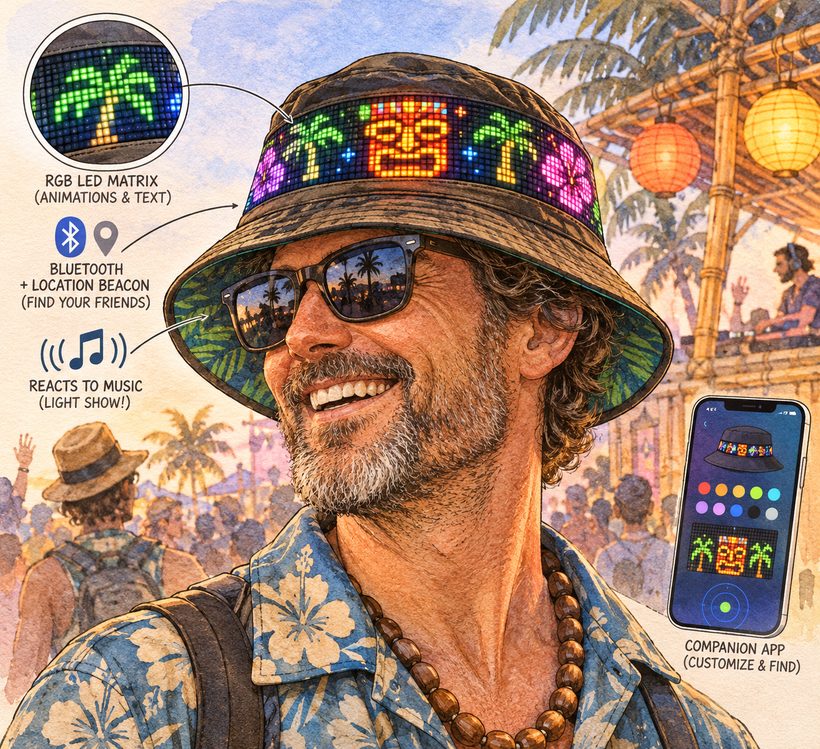
Concept art: a smiling man in a Hawaiian shirt and a bucket hat whose LED band shows a tiki mask, palms and hibiscus at a dusk festival, with callouts for the LED matrix, the Bluetooth location beacon, music reactions and a phone app
"Meet at the tiki bar."Scrolling round his hat above the crowd at dusk, while his friend's phone says she's getting warmer. Stage 2 concept art, the hosts' favourite.

A screen all the way round

This is the band's art from the CAD model, pixel for pixel. Pick a show to see what the hat would run once the app has sent it.

…Estimated from the design's power budget: two 1200 mAh cells, and about 0.4 mA for every LED, even a dark one. Nothing has been measured yet.

43D model in Solidcraft

The band, not the hat

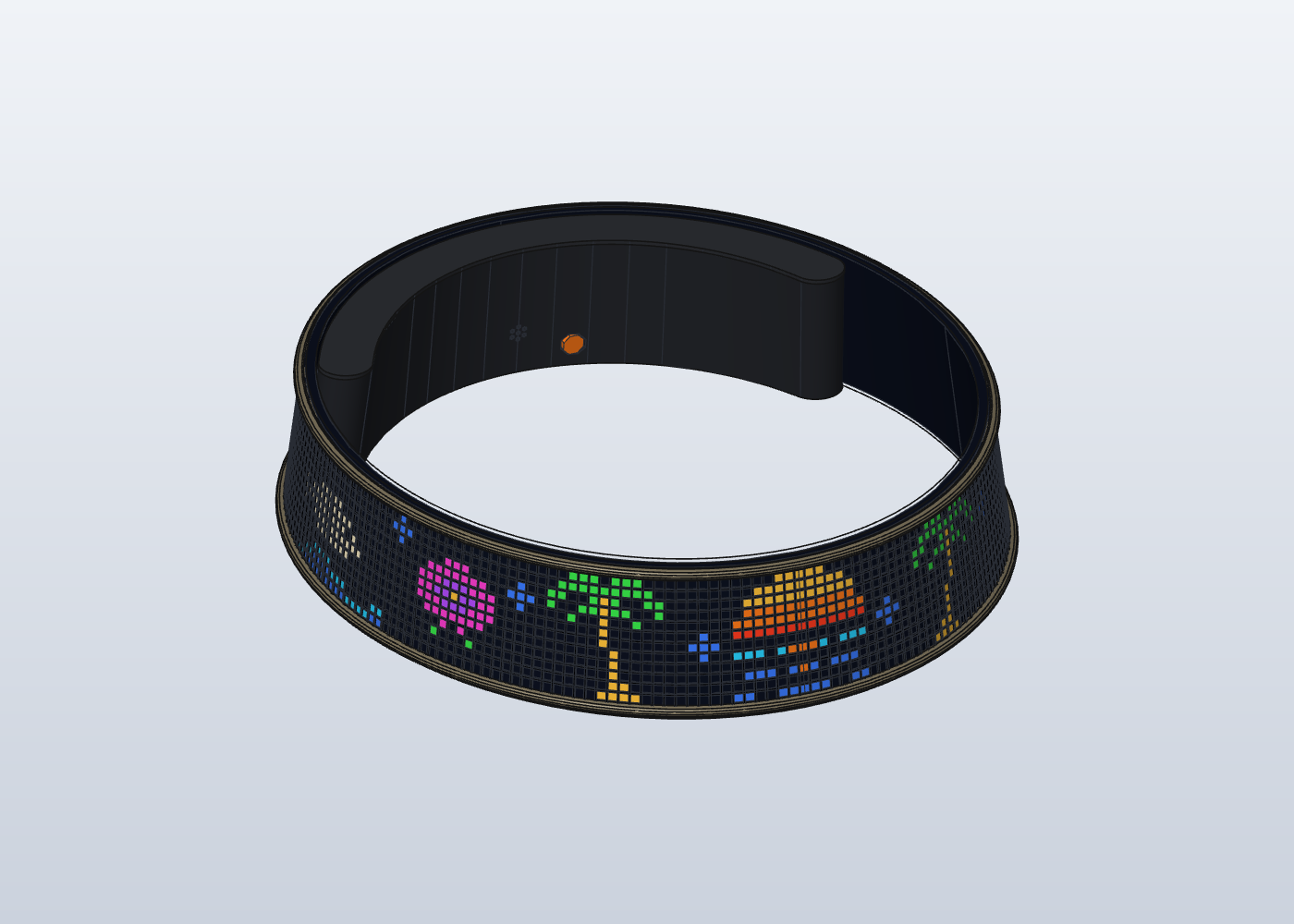
The product is the LED band a hat maker would sew into an ordinary bucket hat, so that's what the CAD models: an oval 182 × 208 mm and 39.6 mm tall, leaning in 7° to follow the crown, with the electronics pod hidden inside at the back. Drag to spin it.

  1. Pixel screen12 rows × 208 columns of square pixels at 2.8 mm, under a black louvre grid on a deep-navy ground. Unlit, the hat just has a dark band.
  2. Piping cordsA fabric cord along the top and bottom, where the band is sewn to the crown and the brim seam. A hat maker would wrap them in the hat's own cloth.
  3. Hidden podA charcoal TPU pod inside the back, behind the sweatband: the board, two flat cells, a mic port and an orange mode key. Nothing shows from outside.
  4. USB-C, facing downFold the sweatband down to charge. The two halves of the band plug into the pod, so the electronics could come out before the hat goes in the wash.
5Electronics in KiCad

What's inside

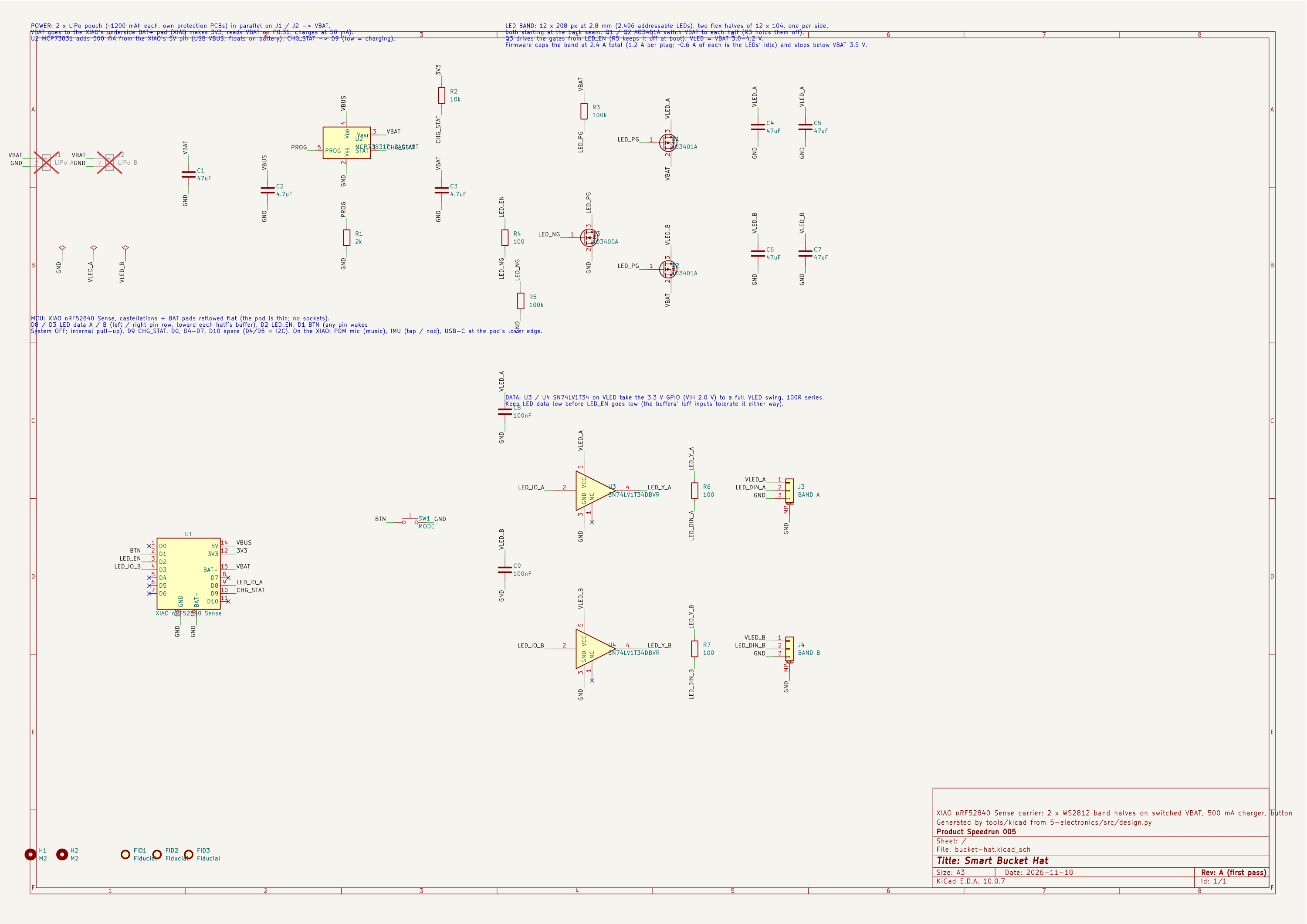
One 50 × 34 mm two-layer board stands in the pod, leaning with the band. A Seeed XIAO nRF52840 Sense is soldered flat in the middle and brings the radio, the microphone and the motion sensor; the board around it only adds what a 2,496-pixel band needs.

0 / 0DRC violations and unrouted connections
PassThe routed board checked inside the pod in CAD: no overlaps
~1 AWhat the band would draw with every pixel dark
~5 hTo charge both cells at about 550 mA
Routed in KiCad with Freerouting
U1 · XIAO nRF52840 Sense

The brain

Bluetooth 5 for the app and the friend-finder beacon, a PDM mic to hear the beat, a motion sensor for tap and nod gestures, and the USB-C port.

LB1–LB2 · custom flex, 12 × 104 each

The screen

Two halves of 1,248 addressable RGB LEDs, both starting from the back seam, each with its own data line so a frame takes ~37 ms (about 25 fps).

Q1–Q3 · AO3401A × 2, AO3400A

Band power switch

Cuts the band's ~1 A idle draw whenever it isn't showing anything, and keeps it off at boot.

U3–U4 · SN74LV1T34

Clean data

Lift the 3.3 V data to the cell's full voltage, so it stays clean over ~30 cm of band carrying amps of LED current.

J3–J4 · JST PH 3-pin, SMD

Unplug to wash

One plug per band half. Side-entry surface-mount plugs keep the board thin enough for the pod.

U2 · MCP73831

Faster charging

Charges at 500 mA, filling the pack in about 5 hours. The XIAO's own charger would take about a day.

SW1 · PTS810

Mode key

Under the sweatband: press for the next show, hold 2 s for beacon only, hold 5 s for off.

BT1–BT2 · 2 × LiPo 603450

Power

Two ~1200 mAh pouch cells, one in each wing of the pod, to spread the weight round the back of the head.
Full bill of materials (… lines)
Loading the parts list…

How we got here

Product Speedrun rolls five random ingredients, and two hosts take them from brainstorm to a routed board in one episode. This roll: an nRF52840, an angler, a wearable, a tiki vibe and "reacts to music".

The episode, in short. A quick walk through episode 005, from the idea to the LED band and its board. Pressing play loads the video from YouTube. Watch it on YouTube
  1. Concept art: an older angler in a khaki bucket hat on a boat, the band showing a pixel fish over waves and pine trees
    ConceptThe angler's version, beside the festival poster above
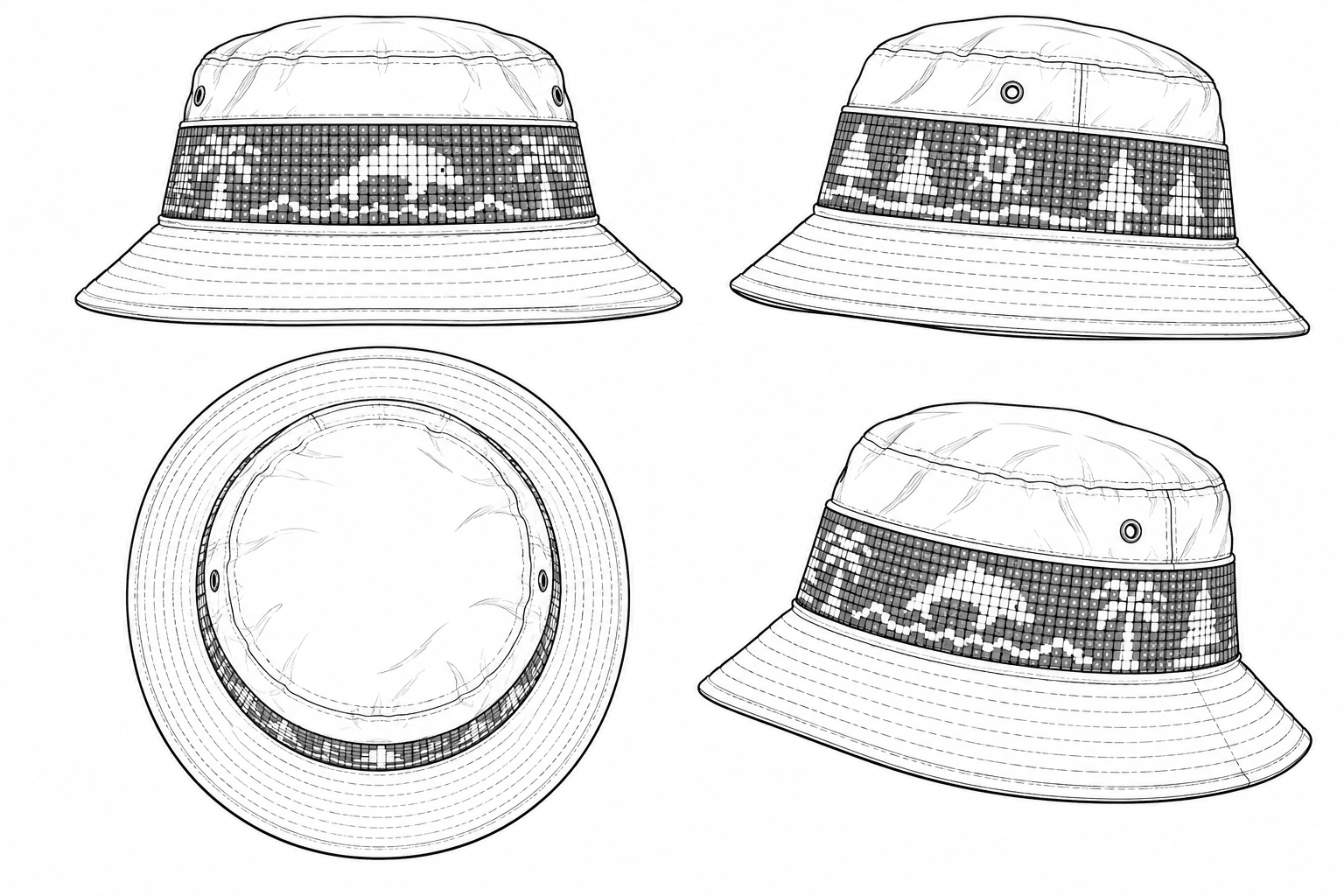
  2. Control drawing: front, three-quarter and top views of the hat with its pixel band
    Control drawingFront, three-quarter and top views
  3. Isometric view of the CAD model: the oval LED band with its sunset and palm pixel art, and the pod inside the back
    3D modelThe band and its pod in Solidcraft
  4. The schematic
    ElectronicsThe schematic

What we still don't know

This is a speedrun first pass. Here's what we'd answer before anyone orders a board or sews a band into a hat.

  • Runtime

    About an hour of show, not a whole night

    Addressable LEDs draw about 0.4 mA each even when dark, so 2,496 of them idle at around 1 A. Two 1200 mAh cells would give roughly 1–1.5 hours of show. Bigger cells, fewer rows or a scanned LED driver on the flex would all add time, and none has been chosen yet.

  • Screen

    The band isn't an off-the-shelf part

    Stock flexible LED panels have 10 mm pixels. A 2.8 mm pitch means a custom two-layer flex with tiny 1515- or 1010-size LEDs. Whichever has the lowest idle current sets the runtime, and it needs measuring.

  • Comfort

    Is the pod comfortable?

    It spans about a third of the band at the back of the head and is 13.6 mm deep, behind the sweatband. Shorter cells would make it ~26 mm shorter. Nobody has worn one yet.

  • Controls

    Where should the button live?

    The mode key sits under the sweatband. A tap or a nod, read by the XIAO's motion sensor, could replace it without adding a visible button.

  • Finding

    Warmer or colder, not a map

    Friends' phones would judge distance from the Bluetooth signal strength. Showing real positions on a map would need the wearer's phone to share its location: an app feature, not hardware.

  • Board

    Routed and checked, but never built

    The first prototype has to confirm the XIAO's battery pads, which end its antenna is at, and that its USB-C path can feed the 500 mA charger.

Build on it

Everything behind HeadLine is open: the 3D design, the KiCad boards and the notes. Download it, change it, make it, even sell it. All we ask is a credit and a link back.

Open the project on GitHub

Continue it with an AI agent

Paste this into Claude Code, Codex, Cursor or any agent that can run commands. It fetches just this project and its part libraries, reads the notes in the right order, and asks you before it changes anything.

Hardware under CERN-OHL-P v2, words and images under CC BY 4.0, code under MIT.

Get each run by email

A short diary of every episode: the roll, the turns the idea took, and the board at the end. One email per episode.